Triosence: Turning Points – Delightful Contemporary Trio Jazz from Germany

I’ve written several times before about Jazz piano trios, as this is one of my favorite art forms, be it with Shai Maestro, Keith Jarrett, or Edgar Knecht.

I’ve already mentioned that Europe in the Shai Maestro post that many of today’s Jazz piano trios seem to come from Europe. Germany is one of the hotspots. Don’t ask me why, maybe it is because there are enough Jazz schools around to produce outstanding musicians, but these days, there are quite a number of German trios that deserve to be better known than they are, including Julia Hülsmann, the Tingvall Trio, the already mentioned Edgar Knecht, Michael Wollny’s excellent efforts, etc. etc.

Triosence

Triosence was started by Bernhard Schüler on piano, Stephan Emig on drums and Matthias Nowak on bass, but the latter has been replaced by Ingo Senst. Both Schüler and Emig come from the same German town of Kassel originally, a rather ugly industrial place that has been completely destroyed in the 2nd world war and unfortunately rebuilt with too much cheap concrete. It cannot be this city that has inspired so much beautiful music.

I currently have four of their seven officially released albums including First Enchantment, Away For A While, One Summer Night (Live), and Turning Points, and all of them are highly recommended. I’ll eventually add all of their albums to my collection.

As an example of their production, let me write about their 2013 Sony album “Turning Points”, which happens to be my favorite (but by a very slight margin, as the other are really great as well).

Turning Points (Sony Classical 2013)

Triosence Turning Points 2013 Sony Classical

It already starts with my favorite track, No One’s Fault.

Why do I like this track so much? Well, it gives me just what I want most: beautiful melodic development. I’m a sucker for melodies. My mind is probably rather simple, I just love melodies. This is probably one of the reasons why atonal classical, free jazz etc are just not my cup of tea, my little brain cannot cope with that freedom. But give me a beautiful melody, as developed here by Schüler, add beautiful bass lines including a lot of use of the bow by Emig, and just the right amount of drums (I personally hate it when drummers overdo it), and I’m in paradise.

My other 5 star tracks on this album are the ballad Your Nearness, the groovy Go For It, and their beautiful interpretation of the Kurt Weill standard Speak Low, where the bass gets to play the melody for a while.

If you do speak German, the 12 min documentary on their website is also worth checking out, explaining how on purpose they went to Norway to record this album: http://www.triosence.com/alben/turning-points/

My rating: 5 stars (well somewhere between 4-5 stars actually, but I love some of the 5 star tracks enough to put the balance towards the top rating)

You can find it here (Qobuz).

Shai Maestro – This Avishai Cohen Alumni Will Go Places

Avishai Cohen

You cannot write about Israeli Jazz without mentioning Avishai. This bass player from Jerusalem probably is the most prominent Israeli Jazz musician, after being “discovered” by nobody less than Chick Corea back in 1996. Personally, unfortunately, I’m not such a big fan of his albums, there are some individual tracks that I really like, but there isn’t a single album I really love throughout.

Shai Maestro

Luckily, he in turn discovered Shai Maestro, when needing a piano player, and he hired him pretty much directly out of school apparently. Talk about risk-taking, but well done! You’ll hear Maestro playing the piano on Gently Disturbed, Sensitive Hours, Seven Seas, and Aurora. During this time, Maestro relocated to New York City, probably a smart choice for a Jazz musician.

Then, in 2011, at the tender age of 24, Shai Maestro decided he wanted to launch his own trio, together with Jorge Roeder (from Peru) on bass and Ziz Ravitz (Israel) on drums, and they launched their first album, simply called Shai Maestro Trio, in early 2012, on the French label Laborie Jazz.

Shai Maestro Trio Laborie Jazz 2012

I had heard Shai Maestro shortly after that on his first European tour, and fell in love with the music immediately. From what I could see during the concert, the guy is not only abrillant musician, but also very modest and humble

Since the debut album (pictured above), Maestro has recorded two more albums, The Road To Ithaca and Untold Stories (the latter including some live tracks), both are very good, but his debut still is my favorite album.

There is just such a beautiful mixture of evolving melodies, some Middle-Eastern influences, and a great understanding of the piano trio tradition (legend has it Shai discoverd Jazz at the age of 8 with an Oscar Peterson album), that you just don’t stop listening to this beautiful album.

And if you get the chance to see him live, go for it. The handful of live tracks on Untold Stories gives you some idea on what to expect, but the additional time and freedom the trio has live just creates something very very beautiful. They really interact as if they’d been together for decades.

This is one of the few musicians where I’ll safely buy any future album blindly. He’s only 28 now, so we’ll hopefully be enjoying many more albums in the future.

My rating: 5 stars (yes I know, I keep giving 5 stars quite often recently, but it is just so much more fun writing about the truly outstanding albums).

You can download it here.

Edgar Knecht – Dance On Deep Waters – Transforming  Traditional Songs into Jazz

To me, Jazz Piano Trio is just an outstanding art form, as already discussed on my previous post on Keith Jarrett’s’ Standards vol. 2.

Actually, Standards fits nicely into a number of trios/albums that have shaped and influenced this particular art form. You could start this lineage with Bill Evans first trio, then move on to Keith Jarrett’s Standards trio, and somehow the third level of evolution came with the late Esbjörn Svensson and his trio. He clearly innovated the trio on many fronts.

Many of today’s piano trios would be unthinkable without EST. And we are very lucky that this art form is not only still alive, but thriving.

About 18 month ago I started a thread on another forum on that topic, called “Are we living in the Golden Age of the Jazz Piano trio?“. This thread has now answered the question I was asking with more than 300 posts today and has become an amazing (if unsorted) list documenting how much is happening around us right now!

Edgar Knecht

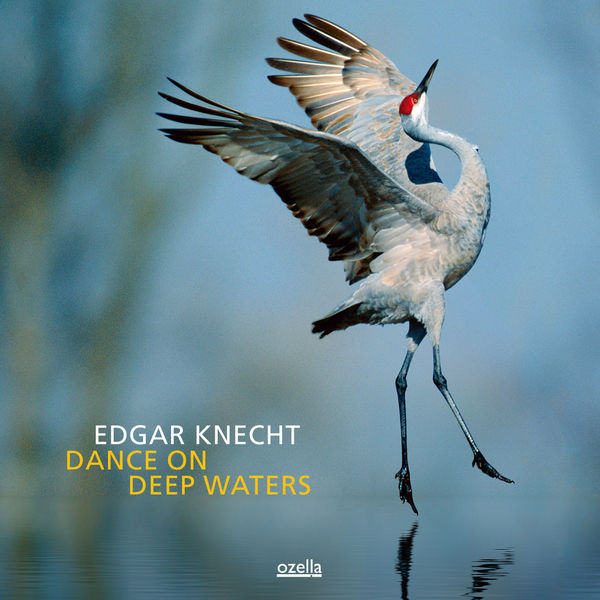
I want to start writing about some of the artists I mentioned or discovered on this thread. Let me kick this off with my most recent purchase, the 2013 album Dance On Deep Waters from the German Edgar Knecht, on Ozella Music. I actually start with a tricky example, this trio is actually a quartet as it includes a percussionist. But well, it is close enough.

Edgar Knecht Dance On Deep Waters Ozella Music 2013

As you can see from the thread, I was actually introduced to this artists (and many other discoveries) by the forum member Elvergunn, who seems to be even more obsessed than me in finding new artists.

(Little side note: The internet is really such a great place for music, you can exchange with music lovers in the entire world, you find stuff that you would have never found in your local record store, and you can all download it in minutes to your computer thanks to the rapidly multiplying specialized online shops, but let’s close the parenthesis here).

Edgar Knecht in my mind is all about melodies and creating a very particular atmosphere. He takes simple music, from German folk songs to even Brahms famous Lullaby “Wiegenlied” and transforms it into something very special. The only little issue I have with this album is that sometimes you’d like a little bit more diversity in terms of approach and style. But I suppose you can’t have it all.

That said, I find this album very enjoyable and keep going back to it quite regularly right now.
My rating: 4 stars

You can get it here as download and here as  CD.

Is the Jazz Piano Trio the ideal art form of the 21st century? – Keith Jarrett’s Standards Vol. 2

Let me answer my rhetorical question immediately: obviously not, there are so many art forms out there today that trying to single out one of them is clearly ridiculous.

So let me rephrase: Is the Jazz Piano Trio my ideal art form? And the answer is, pretty close. There is something special about the intimacy of 3 musicians together, interacting and generating something amazing. It is in a way the modern equivalent of the String Quartet, which many consider the summit of classical chamber music.

I’d like to start by one album which I consider somehow the birth of the contemporary (meaning the last 30 years, I’m starting to get older….): Keith Jarrett’s Standards vol. 2 (footnote: vol. 1 is great as well, I just have a very slight preference for the 2nd volume).

Oh no, you’re going to say, not Jarrett again. Well first of all, you’ve been warned, it is in my subtitle of the blog, and second, I promise I’ll be talking about other musicians as well in the future.

Back to my old friend Keith (not that I’ve ever met him beyond being about 25 meters away last Friday): Why is this album so important?

The lost decade

Well, put yourself in the early 1980s (assuming you were already alive then, I was, but not for long). Jazz just came out of an entire decade of trying to break the “limits” of traditional jazz by first going “Free”, and later by going to Jazzrock and Fusion. Well, I’m sure to offend some here, but to me this was a complete dead-end, and both genres bore me to death (slightly exaggerating to make a point here).

As important as the 70s were for genres like Rock, for Jazz it is my personal lost decade. Most of my collection goes from 1956/7 – 1966, and then starts again in the 80s. So in the early 1980s, we have Keith Jarrett, who already did the amazing solo concerts in the 1970s including the famous Köln concert, apparently the best-selling solo piano album of all times, and had been playing some quartet work both in the US and in Europe (I’ll talk about some of my favorite albums from that period later, so it wasn’t 100% a lost decade, just maybe 90%….).

So then, early 1980s, the bass player Gary Peacock, the drummer Jack de Johnette, and Keith, get together to record first Standards vol. 1, in 1983, and then vol. 2, in 1985. Both are obviously inspired from the key representatives of the traditional piano trio, e.g. Bill Evans first trio, Art Tatum, or Oscar Peterson, but represent something new. And obviously, luckily, don’t contain any element of fusion any more.

Standards vol. 2

I’m not going to review Standards vol. 2 in detail, many smarter people than me have done that. It is an album I keep going back to again and again. I’ve actually just purchased it again very recently. ECM just released some weeks ago a new remaster, now in high-res format of up to 24/192 (bit/khz respectively). Whether high-res files are better than the regular CD format (called 16/44 or “red book”) is a debate I’m certainly not going to start here, you’ll have enough sites to get that discussion going. What is really better is the remastering. ECM; Jarrett’s Munich based record label is known for the excellent recordings, and this new remaster really sounds way better than the CD version. I actually still have the original vinyl in my basement, maybe I should actually get a record player again at some point.

(Footnote again: Do I advocate everybody to get the high res version? It is quite pricey, ECM has always been a premium label. So only get it if you have a decent playback chain and care enough about that album).

So to me, Standards vol. 2 is the “standard” (sorry for the cheap pun) to which I compare all my piano trio recordings.

Since then, the standards trio has recorded many live albums, most of which are outstanding and absolutely worth having. Examples include At the Blue Note, Whisper Not, Standards Live, and even again at the KKL in 2009, Somewhere. (a pity I missed that concert, but at least I have the recording, released in 2014)

Luckily, today we’re living in the Golden Age of the piano trio, we have so many fantastic artists out there that we’re not limited to Keith Jarrett any more. But we really have to thank him for revitalizing this genre (EST then took it to the next level in the 90s, but more about that later).

My rating: 5 stars

UPDATE (Oct 2016): I’ve since reviewed many more Jazz piano trio albums, you can check them all out by clicking on this link.

And please let me know if you have any recommendations for me in the comments section below!

Classical Life

A classical music blog by music critic Tim Mangan

This Week's Music

Making Classical Accessible

From my Macbook to the Net

Evaporation of my thoughts and observations

Elestra

Author: Artienne

My Life in Music

Playing, Singing and Listening

ArsX3

A brand new journal reviewing books, cinema, music

LawrenceEz's Blog

Creative and Performing Arts: Writing, Classical Music, Photography

Laetitia Strauch-Bonart

Contemporary Politics & Culture

sibling revelry

reveling in all things classical

It's A Raggy Waltz

I collect jazz on vinyl, I dig the Dave Brubeck Quartet, & I write about it

La Musica

By two cousins

thejazzbreakfast

Dishing it out from the heart of England

only jazz

random thoughts about music that matters to me

The Culture Project

Exploring the world of literature, wine, art, music and more.

René Spencer Saller

The music causes me to dream of fabulous empires, filled with fabulous sins.

Breaking Baroque

Blog of Tafelmusik Baroque Orchestra and Chamber Choir

Tasting Nirvana

Eating your Dosha

The Immortal Jukebox

A Blog about Music and Popular Culture

April Greene

Writer + Editor

a pianist's musings

A history of your favorite classical music.

Classical music for all

Boris Giltburg's blog

I HEAR VOICES

An orchestra seat in the web space