Another Excellent Recording of the Mendelssohn Piano Concertos by Ronald Brautigam

Mendelssohn again

Pretty much simultaneously two recordings of the Mendelssohn piano concertos were released, by Jan Lisiecki and the Orpheus Chamber Orchestra, as reviewed by me recently, and another one by Ronald Brautigam with the Kölner Akademie under Michael Alexander Willens.

So, which one should you get?

Mendelssohn Piano Concertos – Ronald Brautigam – Michael Alexander Willens – Die Kölner Akademie (BIS 2018)
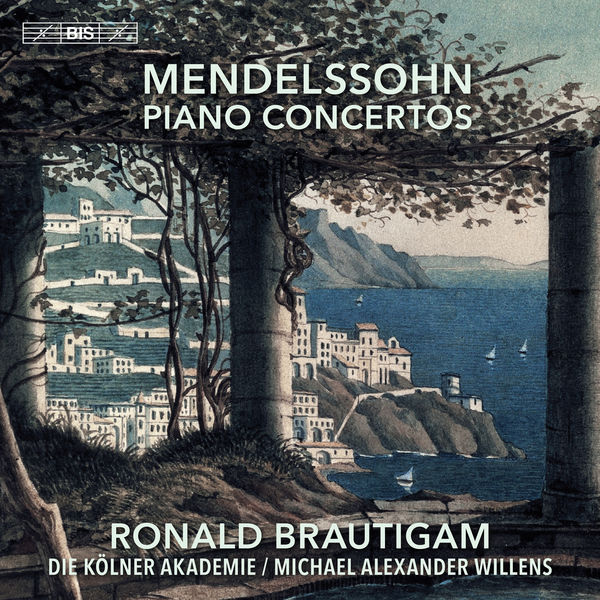
Mendelssohn Piano Concertos - Ronald Brautigam Die Kölner Akademie - Michael Alexander Willens BIS 2019 24/96

Well, it’s not an easy choice.

I won’t do a full review here, as fellow music blogger Konsgaard has already done an excellent job here.

Let me focus more on the differences to Jan Lisiecki. The obvious one is the choice of instruments, Brautigam plays on his typical reconstructed Fortepiano, a Pleyel this time, and the Kölner Akademie clearly plays on historical instruments.

Overall, this gives a rougher, more unpolished, wilder sound than the more polished sound of Lisiecki’s modern Steinway.

Honestly, it’s very hard to choose. Both in their own way are excellent. I probably have a slight preference for Lisiecki and the Orpheus, the sound is just SOOO beautiful.

But then again, Brautigam clearly knows a thing or two about Mendelssohn. Furthermore, the two recordings differ by the choice of the “fillers” that you get on top of the piano concertos.

For Lisiecki, he intersperses some of the beautiful solo piano pieces. Brautigam and Willens instead go for some other lesser know pieces of the piano and concerto repertoire, the Rondo brilliant, the Capriccio brilliant, and the Serenade and Allegro giojoso. None of these works are particularly memorable individually, but taken together they really complement the piano concertos well, and are nice discoveries.

So back to the question, which one to choose? Well, while
my slight preference goes to Lisiecki, in the days of streaming, just check out both and make up your own mind. You won’t regret either of the two.

My rating: 4 stars

You can find it here (eclassical).

UPDATE March 30, 2019: Classica likes this a lot as well giving it 5 stars.

Wishing you a Merry Christmas with Joey Alexander

Christmas Music

I was hesitating a moment to call whether I should call this thread “Happy Holidays” instead of “Merry Christmas”, as I’ve no idea what religion my dear readers are following (if at all). 

I then decided against it, for several reasons. A) I’m personally not religious at all, but grew up in Europe where Christmas is the most important holiday and B) I hope that if you’re following any other religion and don’t particularly care for Christmas, you either just skip this post or, even better, still check out the album below, as it is actually really nice.

If you want more Christmas music, be it Jazz or Classical music, I suggest you also check out my Top 5 Christmas Jazz post, my Favorite Seasonal Music, my recommendations for the Messiah, and obviously, the Christmas Oratorio.

A Joey Alexander Christmas (Motema 2018)

A Joey Alexander Christmas (Motema 2018)

This “EP” (a concept really a bit outdated in the world of streaming and downloads) of only 4 tracks features some outstanding musicians.

I haven’t mentioned Joey Alexander yet. A big mistake. It’s actually an amazing story. He comes from the Jazz hotspot of Bali (sorry, cheap pun), and played at the Lincoln centre at the age of 10, and started recording music at the age of 11!!!! Now he still is at the tender age of 15, and if you wouldn’t see it in the video below, you’d have now way of knowing.

He’s playing here both solo and trio. On the trio tracks we get Larry Grenadier of Brad Mehldau fame, on bass, and Eric Harland, who’s played with a lot of Jazz celebrities (MyCoy Tyner, Dave Holland, etc.).

This EP features two seasonally inspired tracks, O Come All Ye Faithful (see the Youtube clip below), and What A Friend We Have In Jesus.

As an add on, we get remastered versions of My Favorite Things, a duo with Larry Grenadier, recorded in 2015 (I’ll let you do the math of Alexander’s age at the time, but its just unbelievable), as well as a solo version of A Wonderful World. Both are just fantastic.

A truly enjoyable album that  you shouldn’t limit only to the Christmas season!

My rating: 4 stars 

You can find it here (Qobuz) or here (several others)

Bertrand Chamayou plays Saint-Saëns’ Piano Concertos No. 2 and 5 – A Review

Camille Saint-Saëns

Camille Saint-Saëns is one of those composers that outside of his native France isn’t that well known. Sure, many of us will have heard his most famous piece, Le Carnaval des Animaux (The Carnival of the Animals), if you’re a little bit deeper into classical music, you may know his Organ Symphony (no. 3). 

And typically, that’s where most average classical listeners wits will end. I must admit it was very similar for me until quite recently. In fact, this is the very first time I even write a blot post about this composer. 

However, nicely enough in the recent months, two new recordings of some of his piano concertos were released, triggering my interest. Both feature his apparently most famous concerto, no. 2. The first new release, with Louis Lortie, Edward Gardner, and the BBC Philharmonic, is more complete, featuring also concertos no. 1 & 4. You’ll find it on the Chandos label (and here on Qobuz). However, I overall have a slight preference for the other new release of 2018, namely: 

Saint-Saëns: Piano Concertos No. 2 and 5 – Bertrand Chamayou – Emmanuel Krivine – Orchestre National de France (Erato 2018)


The 2nd concerto starts like a Bach solo work, which as a great fan of Johann Sebastian I really appreciate. But obviously, this is concerto of the romantic era (written in 1868), and once the orchestra sets in, there is no doubt about that. The concerto isn’t very “balanced”, the first movement being nearly as long, and “heavier” than the two other movements together. 

You’d never be able to tell this work was written in only 17 days (it was written in a rush for Anton Rubinstein), and it is for a good reason the best known of the concertos.

That said, don’t skip concerto no. 5. It is a bit more intimate, but has many beautiful moments as well.

I’ve praised Chamyou for his beautiful Ravel box, and his playing is brilliant here as well. The ONF does a great job too, I believe they have a natural advantage over foreign orchestras as Saint-Saëns still gets much more air time in his home country and abroad. 

To complete the album, Chamayou also plays several of Saint-Saëns Piano works, which were completely unknown to me. A particularly beautiful example are the 6 Etudes op. 111, that really show a close relationship to Debussy and Ravel, reminding us that Sain-Saëns lived long into the 20th century (he died in 1921).

Overall, a very enjoyable album that I highly recommend

My rating: 4 stars (5 star playing, 4 star repertoire)

You can find it here (Qobuz) and here (Prestoclassical)

Víkingur Ólafsson’s Beautiful Bach

Should Bach be romantic?

Let me start by asking the more fundamental question: Should Bach be “allowed” to be played on a contemporary piano?

I personally think Bach wouldn’t have minded. Keyboard instruments were under constant evolution during his time, he was very open to adapting music from one instrument to another (and often did so with his own work). Now, what Bach would have done had he been able to ever play a modern Steinway is a very interesting, if rather theoretical question.

Now, does playing on a modern piano allow you to have a “romantic” sound while playing good old JSB?  Let’s explore this thought with this recently released album.

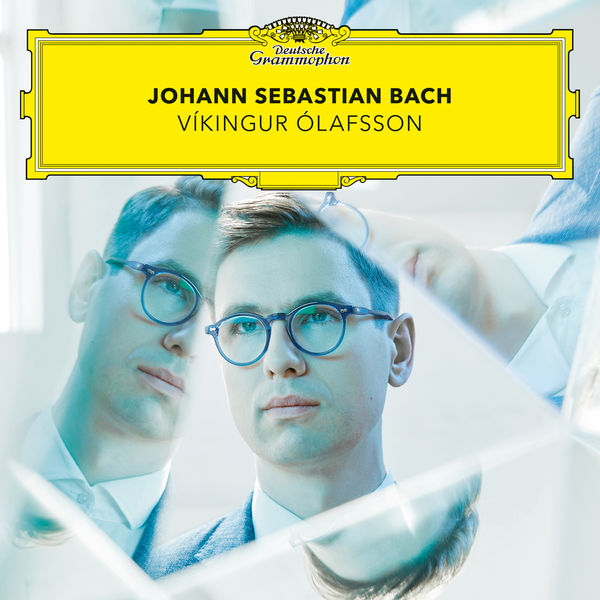
Víkingur Ólafsson: Johann Sebastian Bach

Víkingur Ólafsson Johann Sebastian Bach Vikingur Olafsson Deutsche Grammophon 2018 24/96

Víkingur Ólafsson is only the second Icelandic musician I know (Silly Bjork jokes, anybody?).

He rose to fame at rather young age with his Philipp Glass album (and being signed by Deutsche Grammophon), now he releases his first venture into Bach.

To give you an example what I mean by “romantic”, is track no. 31, the adagio from BWV974. In a way, this could easily be the slow movement of a Mendelssohn or Schubert work.

Do I mind? Au contraire, I really like this album. It is a very personal approach, a very personal selection of material as well. But it never falls into the trap of being the only thing you’re not allowed to be with Bach, which is boring.

To make this album even more appealing to me, we get yet another piano transcription of one of the violin partitas (see here for my original article on the topic)

And also when you take individual well known works like the excerpts of the Well Tempered Clavier, it is very apparent that Olafsson knows what he’s doing, even compared to famous reference versions.

So to answer my initial question: it’s a very clear yes!

My rating: 4 stars

You can find it here (Qobuz) or here (Prostudiomasters)

Well, I Actually DO Like Scarlatti – A Review of Jean Rondeau’s Latest Recording

Domenico Scarlatti

I had written previously some time ago that I don’t particularly like Scarlatti. Or to be more precise, to quote myself “I’ve never heard any Scarlatti that has touched me”.

I got quite a lot of readers comments on this, recommending some very good recordings of Scarlatti. And while there were some that I found somewhat interesting (e.g. Pletnev), I still really hadn’t found my way into the universe of Scarlatti.

I’m pleased to report I’ve finally found the first Scarlatti album I go back to on a regular basis.

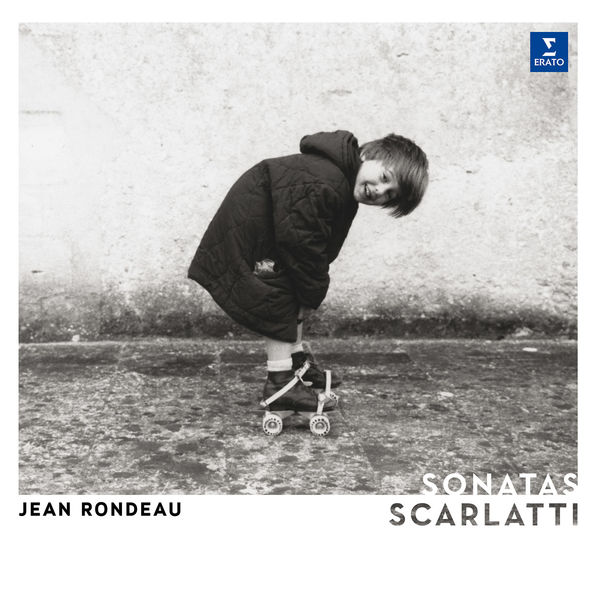
Scarlatti: Sonatas – Jean Rondeau (Erato 2018)

Scarlatti Sonatas Jean Rondeau Erato 2018 (24/96) Warner Classics

I’ve mentioned Rondeau’s very good Bach album here; I really like this young French harpsichord player.

So I was naturally curious about his take on Scarlatti? Would it finally be for me?

Well, I’ve given it away above, the answer is a clear yes.

To be fair, an important factor is the very beautiful sound of the harpsichord Rondeau is playing, apparently a quite recent construction built in 2006 after historic German models by Jonte Knif and Arno Pelto just has a fantastic roundness, and none of the sometimes annoying characteristics of the harpsichord that can be annoying for longer listening sessions.

Rondeau,  winner of the first prize at the International Harpsichord Competition in Bruges, plays these with a power, energy, and conviction that is just blowing me away. Some other Scarlatti recordings sometimes can have that “typewriter” playing, none of that here.

I’m curious to hear what the Scarlatti experts, which I’m clearly not, will be saying about this new album.

In the meantime, I can strongly recommend you check it out!

My rating: 5 stars

You can find it here (Qobuz) and here (Acoustic Sounds)

Igor Levit – Life – A Beautiful Treasure

Does Gramophone read my blog?

I presume not, but it’s a nice coincidence that just a short time after I write a dedicated blog post about the piano transcriptions of Bach’s Chaconne, Gramophone releases a complete review of all historic recordings of Busoni’s transcription of the Chaconne. That’s great news for me as well, as there a lot of versions I haven’t checked out yet.

One very new one is also not yet mentioned in this review article, which brings us to this album.

Igor Levit – Life (Sony Classical 2016)

xojnuoc6qpxsb_600

If you’re a regular reader of my blog, you know that I’m a huge Levit fan. Not only I’ve praised his Bach/Beethoven/Rzewski album, but to me he is clearly one of my favorite pianists of all times.

He has a very particular style. There is a certain perfectionism (his outstanding technique clearly helps), but it is never going towards the mechanical perfection of some virtuosos, the perfectionism, particularly about timing, is always serving the music.

Levit doesn’t tend to be a virtuoso in general, he could easily be with his mastering of the piano, but he really never shows off. In many way, it is a very introvert way of playing which makes it even more interesting.

This album in many ways shows an even more intimate side of Levit. It is a very personal selection of music, from Busoni, via Schumann, to Rzewski and even Bill Evans. The common thread of the album can be found in the title, “Life”, as this album was strongly influenced by the death of a close friend of Levit.

The album starts with two transcriptions by Busoni of Bach originals. The Chaconne is a very good example of the intimate style I described above, in many ways it is the complete opposite of the somewhat overwhelming fireworks in fascinating recording of the same work by the young Benjamin Grosvenor. EDIT Dec 2018: A reader kindly pointed out to me that the Chaconne is actually Brahms’ transcription for the left hand, a much more subdued affair than Busonis fireworks. So basically this entire paragraph is just rubbish. I’ll leave the original text on just to alert you that sometimes I could benefit from doing some more background research when writing my reviews. In the meantime, take my notes with a grain of salt.

We continue with a rarely played variations work by Schumann, which makes me really hope that Levit will record more of his work. I’d love to hear his take on the Davidsbündlertänze or the Kreisleriana.

Another highlight of this album are the two Wagner transcriptions, from Parsifal and Tristan. I must admit not being a great fan of Wagner in general (this is actually the first time this composer even appears on this blog), but he clearly has written some great harmonies.

The album wraps up with one of my favorite compositions of Bill Evans, the simple Peace Piece from the 1958 album Everybody Digs Bill Evans. 

There really couldn’t be a better ending to this very particular, personal album than this solemn, simple, but breathtakingly beautiful interpretation.

My rating: 5 stars

You can find it here (Qobuz) and here (Acoustic Sounds)

A Review of a VERY BIG Rach2 by Trifonov and Nézet-Séguin – Stunning

Daniil Trifonov and Yannick Nézet-Séguin

If you are a regular reader of my blog, you know that I’m a big fan of both artists (e.g. see here for my review their previous Rachmaninov album, or here for a report my recent experience of Nézet-Séguin live, or just use the search function).

Trifonov is without doubt one of the best pianists of our age, and I start to regret not having included him in my list of my Top 10 classical pianists, maybe that blog post needs an update at some point. And Nézet-Séguin is on his path to be one of the truly great conductors of the 21st century.

So when I saw they just released the legendary Rach 2 together, I bought the album immediately.

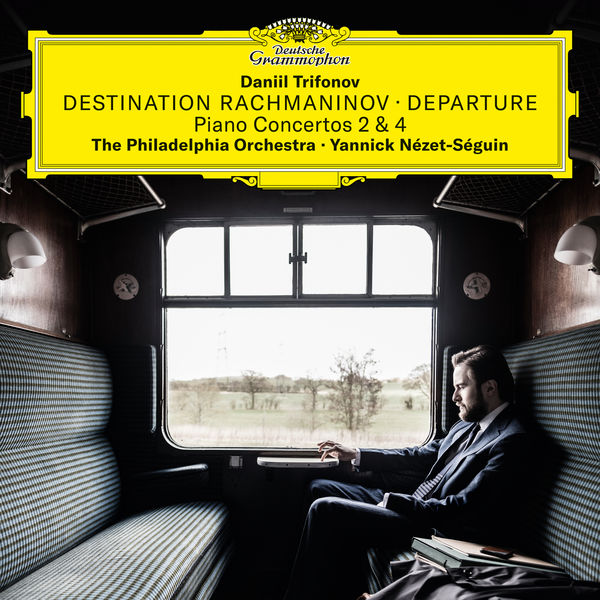
Destination Rachmaninov: Departure. Piano concertos No. 2 & 4 – Daniil Trifonov – Yannick Nézet-Séguin – The Philadelphia Orchestra

Daniil Trifonov Yannick Nézet-Séguin The Philadelphia Orchestra Destination Rachmaninov - Departure Deutsche Grammophon 2018 24/96

There is no lack of great recordings of Rach2. Andsnes, Zimerman, Buniatishvili (although this recording is bit controversial), not to mention the greats like Richter, or even the composer himself.

How to play this piece? Do you try to keep it more factual, or do you go with the full romantic power of the piece?

Some lessons can be taken from the recording of Rachmaninov with Leopold Stokowski, featuring the very same Philadelphia Orchestra than the current recording. And one thing is clear, already at the time (1924), they went BIG. A lot of power, a lot of rubato, a lot of everything. And guess what, that works! (well the composer should know, you’d presume)

Trifonov and Nézet-Séguin take a very big approach here. You can really float in the big sound of the Philharmonia Orchestra, and soloist and conductor clearly connect. Trifonov clearly is a virtuoso of the highest caliber, so the technical challenges of this massive work just go unnoticed.

Overall, there is a lot of rubato, and the tempo is relatively slow. In some of the slower passages, one even gets reminder of a Bruckner symphony.

Some would argue this is too much. I haven’t seen many reviews yet, but I predict this recording will be a love it or hate it affair.

To make it clear: I love it!

You also get concerto no. 4, but to this day, I’m like quite a large majority of music lovers, I love nos. 2 and 3, and just don’t get 4. So no comment from my side.

What you do get on top is much more interesting, at least to me. Rachmaninov did his transcription of the Violin Partita BWV 1006, a true gem, that I should probably add to my blog post on transcriptions of the Chaconne. Very much worth discovering.

I’m kind of curious about the album title, Departure, and am really wondering where this train takes us next. Let’s hope to an equally spectacular Rach 3!

My rating: 5 stars.

I’m curious to see if my prediction holds true, and there will be both raving and bad reviews of this. I’ll report back when I see them. In the meantime, try before you buy!

You can find it here (Qobuz) or here (Prostudiomasters)

UPDATE Oct 30: Well, my prediction of this being a very controversial album already holds true. Check out the comments of my readers below, and you’ll find both love and hate.

In terms of professional reviews, we generally are very positive so far, with four stars from Richard Fairman in the FT, five stars by Andrew Clements in the Guardian, another five stars by Normal Lebrecht. I’m still curious what Gramophone and Classica will think of this.

In any case, try before you buy!

Update March 2, 2019: Classica agrees, and gives this album a “CHOC”, their highest rating. Whereas Gramophone is much less impressed “Overall, this is another fine, well-recorded addition to the lengthy discography but one which neither astonished nor moved me.”

So my prediction that this would be a love it or hate it affair, I was spot on. I still like it very much.

Classical Life

A classical music blog by music critic Tim Mangan

This Week's Music

Making Classical Accessible

From my Macbook to the Net

Evaporation of my thoughts and observations

Elestra

Author: Artienne

My Life in Music

Playing, Singing and Listening

ArsX3

A brand new journal reviewing books, cinema, music

LawrenceEz's Blog

Creative and Performing Arts: Writing, Classical Music, Photography

Laetitia Strauch-Bonart

Contemporary Politics & Culture

sibling revelry

reveling in all things classical

It's A Raggy Waltz

I collect jazz on vinyl, I dig the Dave Brubeck Quartet, & I write about it

La Musica

By two cousins

thejazzbreakfast

Dishing it out from the heart of England

only jazz

random thoughts about music that matters to me

The Culture Project

Exploring the world of literature, wine, art, music and more.

René Spencer Saller

The music causes me to dream of fabulous empires, filled with fabulous sins.

Breaking Baroque

Blog of Tafelmusik Baroque Orchestra and Chamber Choir

Tasting Nirvana

Eating your Dosha

Shadow of Iris

Poetry, fiction, short stories, more ...

The Immortal Jukebox

A Blog about Music and Popular Culture

April Greene

Writer + Editor

a pianist's musings

A history of your favorite classical music.

Classical music for all

Boris Giltburg's blog

I HEAR VOICES

An orchestra seat in the web space