Schumann’s Cello Concerto by Jean-Guihen Queyras – A Review

A Trilogy

This is now the third and presumably album of an exciting series by three outstanding musicians.

The German violinist Isabelle Faust (yes, I’m a big fan, see here or here), the Russian pianist Alexander Melnikov, and the French cellist Jean-Guihen Queyras are all great musicians individually, but get even better when they play together.

An excellent example is their recording of some Beethoven Trios on Harmonia Mundi some years ago, and Faust’s and Melnikov’s collaboration on Beethoven’s and Brahms’ violin sonatas are among my absolute favorites (the latter made it as part of my top 5 classical albums in 2015).

In this particular project, the three have decided to attack Schumann, and to couple one of his 3 piano trios with one of his orchestral solo works, playing with the Freiburger Barockorchester under Pablo Heras-Casado, on Harmonia Mundi.

Faust started, coupling his piano trio with his relatively unknown violin concerto back in early 2015. I really like this album.

Some month later Melnikov got his chance to play the famous piano concerto (see my 4 star review here) with piano trio no. 2.

So here we are at release no. 3, focusing obviously on the Cello concerto, and the remaining trio no. 1.

Schumann: Cello Concerto and Piano Trio No. 1 – Jean Guihen Queyras – Pablo Heras-Casado – Freiburger Barockorchester (Harmonia Mundi 2016)
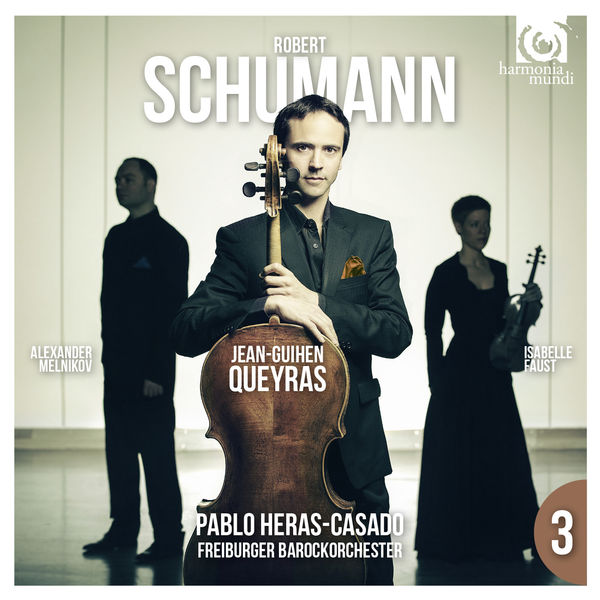
Schumann: Cello Concerto / Piano Trio No. 1 Jean-Guihen Queyras Alexander Melnikov Isabelle Faust Pablo Heras-Casado Freiburger Barockorchester 2016 Harmonia Mundi

I expected quite a lot from this album, given that I really liked the two predecessors. However, on the Cello concerto I’m not exactly getting what I expected.

Schumann to me is one of the highest points of romanticism. I really like the energy, passion, and drama in his orchestral works. However, both Queyras and Heras-Casado chose a more subdued approach here, and I unfortunately constantly feel I’m missing something.

To explain what I mean, let me refer to my two personal reference versions for this concerto, by the legendary Jacqueline du Pré (playing with Daniel Barenboim), and even more, Janos Starker with Antal Dorati and the London Symphony. Do you hear the passion,  the power?

Here is a Youtube example of du Pré:

Maybe I just need to listen to the Queyras version more to get used to it, but so far it just doesn’t pull me in enough.

Obviously, we are talking about an excellent soloist (I really like his Bach Cello Suites for example) with a great orchestra, so fundamentally this remains a good recording, it is just not my cup of tea.

However, going back to the chamber music, all is well. These three trios, spread over 3 albums, will remain my reference version of these works for a foreseeable future.

My rating: 4 stars, averaging 3 stars for the Cello Concerto and 5 stars for the trio.
You can find it here (Qobuz) or here (Prostudiomasters)

Brad Mehldau Trio: Blues and Ballads – A Review

Brad Mehldau

I have an ambiguous relationship to Brad Mehldau’s music. On the one hand, I’ve featured him both in my 25 Essential Jazz albums, and My Top 10 Jazz Covers of Pop Songs, which means there is stuff he’s done I really love and would rate 5 star.

I also liked his recent 10 Years Solo Live album which I have yet to review, and had a ticket for one of his recent solo concerts (which unfortunately I couldn’t attend as a gastric flu had knocked me out).

On the other hand, there are albums I just loathe, and give them a solid two stars (really not my cup of tea), e.g. Largo.

Nevertheless, I’ve been following him quite closely, you just never know what you get next.

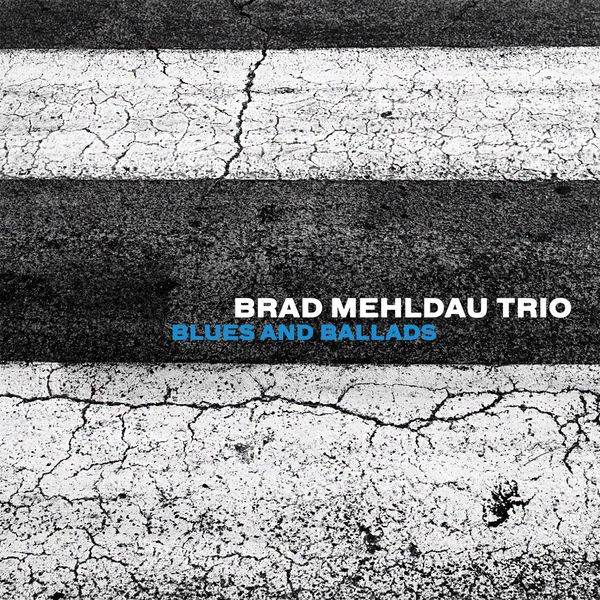
Blues and Ballads (Nonesuch 2016)

So obviously, the moment the new trio album came out (just some days ago), I started streaming it.

So, are we in two or five star territory here?

Brad Mehldau Trio Blues and Ballads 24 88 Nonesuch 2016

Actually, neither nor.

My first impression here is “quite nice”. And not in the indirect sense that the word nice these days is quite regularly used, I actually kind of like it.

There are some beautiful ballads, several of them 9 or 10 minutes long (something I  often appreciate, as it gives the music more time to develop).

Some of my favorite tracks are the two last ones on the album And I Love Her, and My Valentine. These two alone, for my particular taste, make the album worth checking out.

On the other hand, when we go to the first part of the album title, the Blues part, I’m less convinced. There are tracks I personally could easily live without, e.g. Cheryl, where to my ears the trio tries to sound like Monk but doesn’t really succeed.

Another really enjoyable track is the Jon Brion cover Little Person, confirming again that Mehldau plays an important role in bringing the contemporary Pop repertoire into Jazz.  


So overall, a slightly mixed bag, but I still like the good tracks of the album enough to recommend the entire thing. Will I buy this (which I do for my personal favorites and to support the artist) or stick to streaming? Time will tell, but I wouldn’t be surprised if I end up clicking on the buy button eventually.

In any case, give it a try!

My rating: 4 stars (this is one more of the cases where I was hesitating to give 3.5 stars, but I don’t want to stray away from my own rating scale, and the good songs on this album are really worth it).

You can find it here (Qobuz) and here (Nonesuch’s own online store)

Pachelbel: Beyond the Canon with Amandine Beyer

Johann Pachelbel

Do you know Pachelbel? Sure you do. Like probably most of the population of the Western world, from his famous Canon and Gigue in D, as the Canon is one of the most popular pieces played at weddings (and by street musicians).

Now do you know anything else from Pachelbel? Well, I must admit, I really didn’t. In my entire classical music library, I have the sad number of 15 tracks from this composer, pretty much entirely on some Baroque compilations.

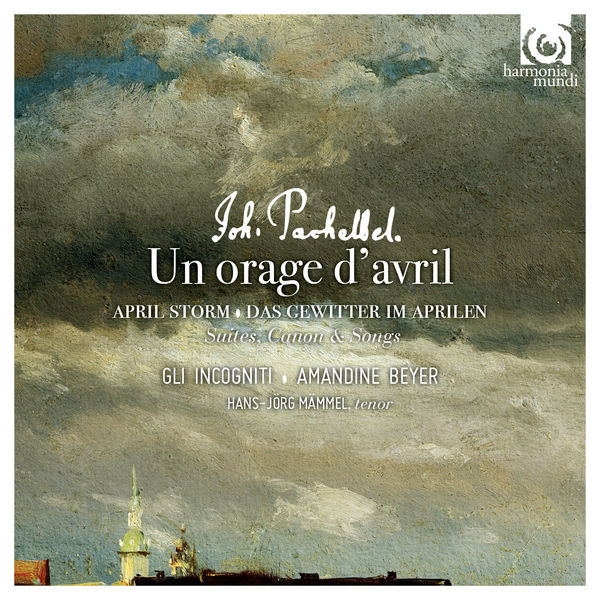
So I was curious when Amandine Beyer with her ensemble Gli Incognito recently released an entire Pachelbel album.

Pachelbel: Un Orage d’Avril (Harmonia Mundi 2016)

Pachelbel: Un orage d'avril - Amandine Beyer - Gli Incogniti - Hans-Jörg Bammel Harmonia Mundi 2016

Well, I was positively surprised. This is mainly instrumental baroque musique, with the occasional song (beautifully performed by tenor Hans-Jörg Mammel) thrown in.

Let’s admit it, baroque music  can be boring. Sometimes it is just a bit too repetitive, to formalized, too much of the same (e.g. quite a bit of Vivaldi’s massive oeuvre IMHO). So it usually takes a genius like Bach to break out of the conventions of baroque music to really make it interesting (and even he doesn’t always succeed).

And obviously, Pachelbel is no Bach, probably not even a Vivaldi. That said, I still think there is enough to discover on this album that I highly recommend you to check it out.

A brief comment on Amandine Beyer: I sometimes find the sound of her violin a bit too “rough” for my taste (e.g. on her celebrated recording of the Four Seasons) This is nicely enough not the case here, the album is quite well recorded.

Give it a try!

My rating: 4 stars

You can find it here (Qobuz) and here (Prestoclassical)

Brahms Complete Piano Sonatas by François-Frédéric Guy – A Review

Brahms’ Piano Sonatas

I’m a fan of Johannes Brahms (see my blog’s subtitle). I’m a fan of his piano works, especially op. 116-119 (which are among his latest works).

However, until recently, his three piano sonatas never really touched me. I just didn’t get them. We’re talking about his op. 1, 2, and 5, so pretty much his first “official” compositions.

No. 3, op. 5, is the most well-known of the works. It is this piece that Robert Schumann heard when the shy 20-year old young man Brahms was at the time was introduced to the famous composer, which lead Schumann to write his famous article about Brahms being” one of those who comes as if straight from God”, and “He has a great future before him, for he will first find the true field for his genius when he begins to write for the orchestra”. 

Well, with hindsight, Schumann was obviously more than right, but it’s amazing he was able to cast such a judgment based on these works. So I always knew there must have been something in these works that I was missing.

My first version ever of op. 5 was by Radu Lupu (not a bad choice actually), and I very quickly also got the famous complete Brahms piano works box from Julius Katchen.

So I didn’t have a bad starting point, but as said before, I never really was drawn into his early sonatas.

But obviously, I try to check out as many new Brahms piano releases as I can. Recently, Geoffroy Couteau released a box of complete Brahms piano works, which got great reviews by the French press. I’m still making my way through that box, but so far I don’t share the enthusiasm of Classica and Diapason. Anyway, more about this later.

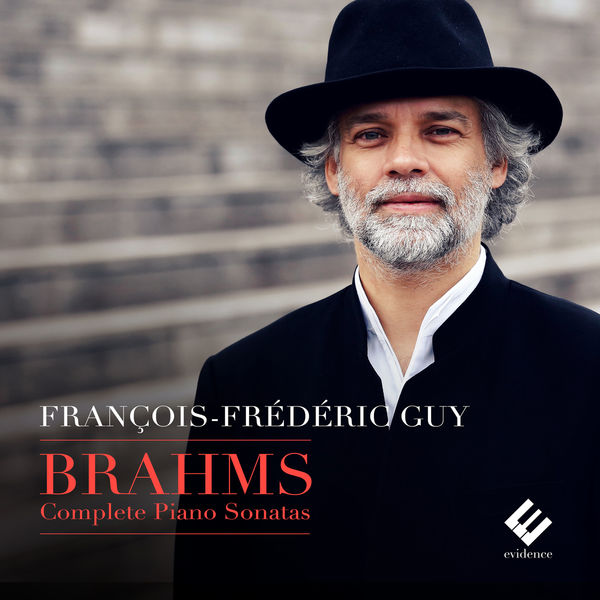
Brahms: Complete Piano Sonatas – François Frédéric Guy (Evidence Classics 2016)

Brahms Complete Piano Sonatas François-Frédéric Guy Evidence 2016 24 48

In any case,  I didn’t expect much when I checked out another French pianist, François-Frédéric Guy’s recent recording of the complete piano sonatas.

And I was very positively surprised! Guy actually specialized in German composers, especially Beethoven and Brahms.

So what makes this recording special? Basically, one thing, passion. I can really hear the 20 year old genius playing at the Schumann’s home in Düsseldorf in this album.

This album doesn’t necessarily sound like “typical” Brahms to me (if there were such a thing). Some softer elements remind me of Chopin, some more energetic moments even sound a bit like Rachmaninov (who obviously wasn’t even born yet when these pieces were composed).


There is a really nice example on Youtube:


This album is absolutely worth checking out.

My rating: 4 stars

You can find it here (Qobuz) or here (Highresaudio)

Bänz Öster & The Rainmakers Live in Willisau – Ukuzinikela

Live Concerts

Last year I clearly haven’t been attending enough live concerts. I have the clear intention of changing this for 2016.

During a recent trip to Hamburg, a friend of mine took me to see a Jazz artist I must admit I hadn’t heard of before, the Swiss bass player Bänz Öster, at the relatively recently established Cascadas Jazz Club in downtown Hamburg.

I had checked out a quick Youtube excerpt of this artist, but was pretty unsure to what I would be expecting. Well, I was very positively surprised.

Bänz Öster and The Rainmakers

Let me write first of all about the other three musicians. Obviously, Jazz is these days a rather international affair, but this was truly an interesting mixture. We had Ganesh Geymeyer on saxophone. He is Swiss as well, but coming from the French speaking part around Lake Geneva.

And then we go to a completely different continent, that at least in my mind wasn’t strongly linked to Jazz, Africa. I was obviously proven wrong. We had a great drum experience from Ayanda Sikade. But the true hero of the evening for me was Afrika Mkhize on piano. This really encouraged me to find out more about the South African Jazz scene.

So what did we get from this quartet? Exciting, interesting and melodic Jazz that often reminded me of Coltrane’s quartet recordings in his best days, but didn’t rely on standards, during the concerts we mostly got recent compositions, many of them written by the musicians themselves.

After such a great evening, I obviously had to immediately buy their new CD which was just released and was available at the concert.

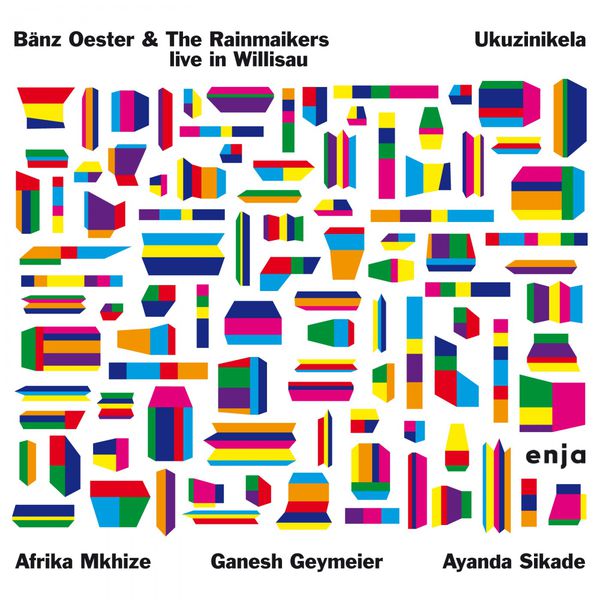
Bänz Öster & The Rainmakers Live in Willisau – Ukuzinikela (Enja 2016)

Bänz Öster & The Rainmakers Live In Willis Ukuzinikela Afrika Mkhize Ganesh Geymeier Amanda Sikade Enja 2016

This live album, in spite of having quite a different track list than the live concert I saw in Hamburg (it was released just now, but already recorded in 2014), truly replicates the pleasure I had listening to these four musicians.

As this is a live concert, the musicians really take their time, the tracks are often more than 10 minutes giving ample solo time. My favorite track of this album is Hungersnot (famine), which after a long two minute intro where Bänz and Geymeyer play unisono, turns into a fascinating groove, thanks especially due to the miracles that Mkhize does on the piano. I’ve said it before, I’m a big fan of him now, he has amazing technical capabilities (the speed is incredible), but he doesn’t have to overdo it, it just flows naturally.

Overall, a live album that is absolutely worth discovering!

Here is a kind of “making of” video for the album:


My rating: 4 stars

You can find it here (Qobuz)


Mare Nostrum II – Paolo Fresu, Richard Galliano, Jan Lundgren

Who says the European Union doesn’t work?

On this album, we have an Italian (from Sardinia), a French, and a Swede, playing together. Isn’t this what the European Union was all about, before it became a bureaucracy?

I’ve already seen Paolo Fresu and Richard Galliano live. The former in a beautiful duo concert with Ralph Towner on Guitar (as recorded on the beautiful ECM album Chiaroscuro); and Galliano many years ago in a fantastic gig with Michel Portal on clarinet (check out their common album Blow Up to get an idea). Lundgren I only know from some albums I own (and like).

The three already played together on the first album, Mare Nostrum, which  was released in 2007. Now, many years later we get the successor album:

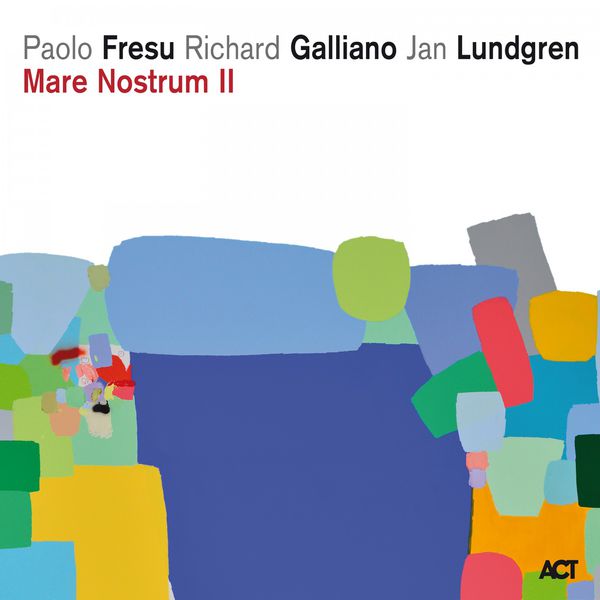
Mare Nostrum II (ACT 2016)

Mare Nostrum is Latin for “our sea” and was the Roman name for the Mediterranean Sea.

Paolo Fresu Richard Galliano Jan Lundgren Mare Nostrum II (24/88) ACT Music

We surely have a rather unusual combination of instruments here. Fresu often plays a Miles Davis-style dampened trumpet, which matches Galliano’s accordeon surprisingly well. Lundgren on piano plays his usually meditative style.

While these aren’t instruments you’d spontaneously assemble into a trio, this album again (like it’s predecessor) works surprisingly well.

My favorite tracks

I have two favorite tracks on this album.

No. 1 is Aurora.This is music for sitting on the deck of a sailing boat somewhere on the Mediterranean Sea with a nice chilled bottle of Rosé and feeling the warm breeze on your skin (sorry for this cheesy analogy, but I’m currently planning my summer vacation in Sardinia, so my imagination probably runs a bit wild…).

No. 2 is the beautiful cover of Satie’s Gnossienne, one of my favorite tracks by Eric Satie. Who know this simple composition could swing?

The only thing that this album could use is a bit more variety, we’re getting a lot of slow sentimental tracks, but I’d have loved at least one or two more uptempo songs, like Leklat.

But beyond this little complaint, this is beautiful music that is able to transport you elsewhere; and just enjoy the moment.

My rating: 4 stars

You can find it here (Qobuz) and here (Highresaudio)

Know What I Mean? What Great Album!

Blogging – but about what?

I suppose every blogger knows this question: what should I write about on my blog?

Well, you could say with several thousand albums in my personal library and 30M tracks in my Qobuz streaming subscription, finding material shouldn’t really be a problem. And it actually isn’t too much of an issue.

The harder question is often: What do I write about right now?

I often get inspired by either recent releases, by reading the specialized press, or by something I just happened to play on my stereo recently.

However, tonight I was a bit clueless. I knew it was time for another blog post, but didn’t really feel inspired about anything in particular.

Then the radio on my car trip back from work came to my rescue, as they played a track from the album below. I immediately knew I had to write about it.

So here we go:

Cannonball Adderley

Julian “Cannonball” Adderley is probably one of the more underestimated saxophone players. He never go the reputation of a Coltrane, Bird, or even Sonny Rollins. That said, he’s done some amazing albums. Not only he played on Kind Of Blue (see my post on my 25 essential Jazz albums), but also on Something Else from 1958 which has the best version ever of Autumn Leaves on it. Not to mention many other great albums, with or without Miles Davis.

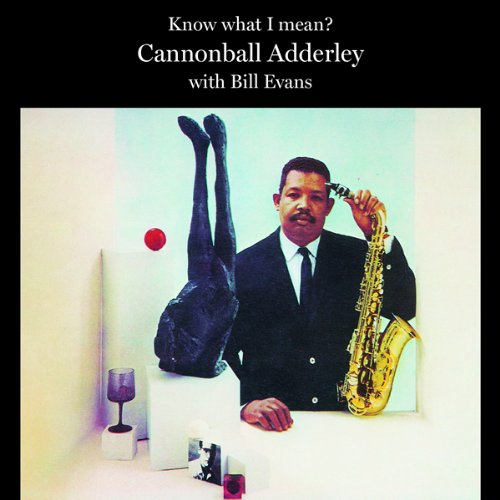
Know What I Mean – Cannonball Adderley With Bill Evans (Riverside 1961)

Adderley and Bill Evans already played together on the above-mentioned legendary album Kind Of Blue in 1959. Two years later, on the Riverside label this time, they work together again, without Miles Davis this time. You have Percy Heath on bass, and Connie Kay on drums.

And the mood is completely different to Kind Of Blue‘s intimacy, this is swinging Jazz that will make you smile immediately.

Cannonball Adderley with Bill Evans Know What I Mean Riverside

You start with the great Bill Evans standard Waltz For Debbie, a song I personally cannot get enough of. And this is probably one of the best versions out there, with Adderley really swinging like crazy.

Toy, a Clifford Jordan original, is another great uptempo track.

And then there’s the title track (which depending on which release you get, you may have several takes to compare), which starts as a beautiful ballad (Kind Of Blue‘s particular mood is popping up again), but soon turns back to softly swinging.

This is mainstream jazz (in the positive sense of the word) at its best.

My rating: 4 stars

You can find it here (Qobuz).

Classical Life

A classical music blog by music critic Tim Mangan

This Week's Music

Making Classical Accessible

From my Macbook to the Net

Evaporation of my thoughts and observations

Elestra

Author: Artienne

My Life in Music

Playing, Singing and Listening

ArsX3

A brand new journal reviewing books, cinema, music

LawrenceEz's Blog

Creative and Performing Arts: Writing, Classical Music, Photography

Laetitia Strauch-Bonart

Contemporary Politics & Culture

sibling revelry

reveling in all things classical

It's A Raggy Waltz

I collect jazz on vinyl, I dig the Dave Brubeck Quartet, & I write about it

La Musica

By two cousins

thejazzbreakfast

Dishing it out from the heart of England

only jazz

random thoughts about music that matters to me

The Culture Project

Exploring the world of literature, wine, art, music and more.

René Spencer Saller

The music causes me to dream of fabulous empires, filled with fabulous sins.

Breaking Baroque

Blog of Tafelmusik Baroque Orchestra and Chamber Choir

Tasting Nirvana

Eating your Dosha

Shadow of Iris

Poetry, fiction, short stories, more ...

The Immortal Jukebox

A Blog about Music and Popular Culture

April Greene

Writer + Editor

a pianist's musings

A history of your favorite classical music.

Classical music for all

Boris Giltburg's blog

I HEAR VOICES

An orchestra seat in the web space