Easter is Coming Up Again: Time to Recommend A New Outstanding Matthew Passion Recording by John Eliot Gardiner

The Matthew Passion

I’ve previously written about the importance of the Matthew Passion here.

It is probably one of the most relevant works of Bach, which in turn makes it one of the most important works of the entire classical music.

If you want a good entry to understand what this is all about, check out this NPR “guided tour” through this masterpiece.

I’ve mentioned previously that I’m not religious at all, but that doesn’t take one bit of the attraction away, the emotions Bach has captured here really has universal appeal.

Bach: St. Matthew Passion – John Eliot Gardiner (SDG 2017)

My previous and still valid recommendation for the Matthew Passion remains John Butt’s outstanding recording of the 1742 version, with the Dunedin Consort. I’ve listed it in my 25 Essential Classical Music Albums.

But when the great John Eliot Gardiner decided to re-record this masterpiece nearly 30 years after his legendary DG Archiv version, I had to write about this.
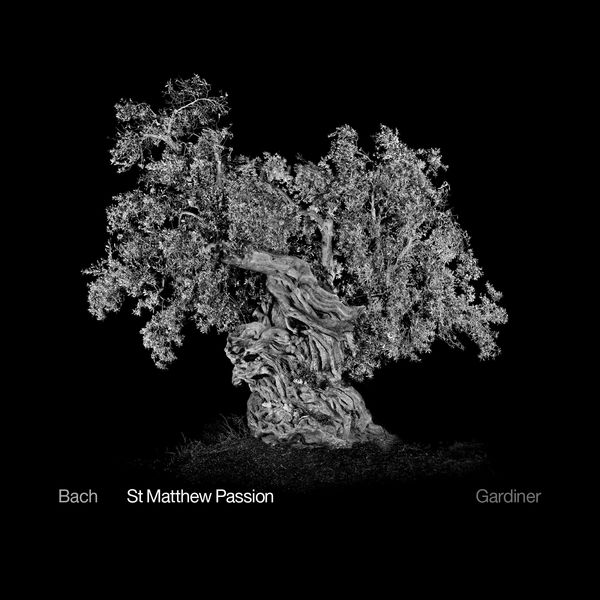
Bach St Matthew Passion John Eliot Gardiner SDG 2017 24/96

Actually, I had heard it even before it was released, as I had the pleasure of seeing Gardiner with his Monteverdi Choir live at the KKL in Lucerne last spring. During this European tour this album was recorded (a bit later in 2016, at Pisa Cathedral).

I don’t know why I didn’t write about this concert before, as it was such an outstanding performance. Therefore, I’m extremely happy it was recorded.

I wasn’t always been with Gardiners recent recordings (see here and here), even his new recording of the b-minor mass left me a bit cold.

But this one is pure perfection again. Gramophone agrees and gives it a “Recording of the Month” for April. Germany’s Fono Forum is also on board, with 5 stars.

How does Gardiner compare against John Butt?

Well, actually there are more similarities than differences. Both are historically informed, both favor transparency over let’s say the power of a Karl Richter.

Both have excellent singers, both have an outstanding period ensemble. As mentioned above, Butt uses the more rarely heard 1742 version, but the differences are small.

Where Gardiner has the edge, is probably in even more increased transparency, in a way it sounds even more intimate. On the other hand, you get a bit more emotional power with the Dunedins in some of the choral scenes.

But here we’re talking very minor differences, it is very clear that Gardiner has recorded a reference version. Do yourself a favor and listen to it.

My rating: 5 stars
You can find it here (Qobuz) and here (HDTracks)

First time at the Elbphilharmonie – finally! Xavier de Maistre’s Harp fireworks with William Christie

The Hamburg Elbphilharmonie

Hamburg’s latest addition to the number of beautiful classical venues, the Elbphilharmonie concert hall overlooking the harbor, is a true masterpiece by Swiss architects Herzog and de Meuron. Completed several years after plan and hugely over budget, most of Hamburg’s population has already forgiven all the bad planning (and their tax euros gone) seeing this beauty finally come alive.

I was lucky enough to buy tickets more than 6 months ago, because since the official opening tickets are basically only available through the black market. Huge media coverage including the New York Times didn’t really help. Well, at least we now have a classical venue that is most likely sold out for years, many other places would be happy to have such a problem, with ageing population and less people interested in classical music.

DSCF5302 Weihnachten 2016
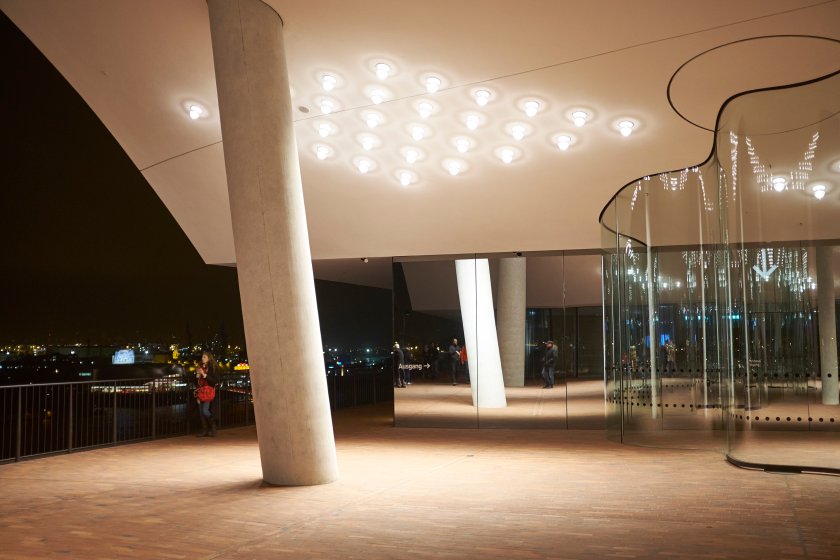
The Elbphilharmonie Plaza

I had been to what is called the “Plaza” (see above), basically the publicly accessible space between the only brick harbor warehouse and the  new steel and glass construction on top, which houses not only the concert hall, but also a hotel, several restaurants, and even some private apartments. If you’re in Hamburg, check it out, the views and the architecture are spectacular. It is located within the fully new part of town call Hafencity, which on its own is already worth a visit.

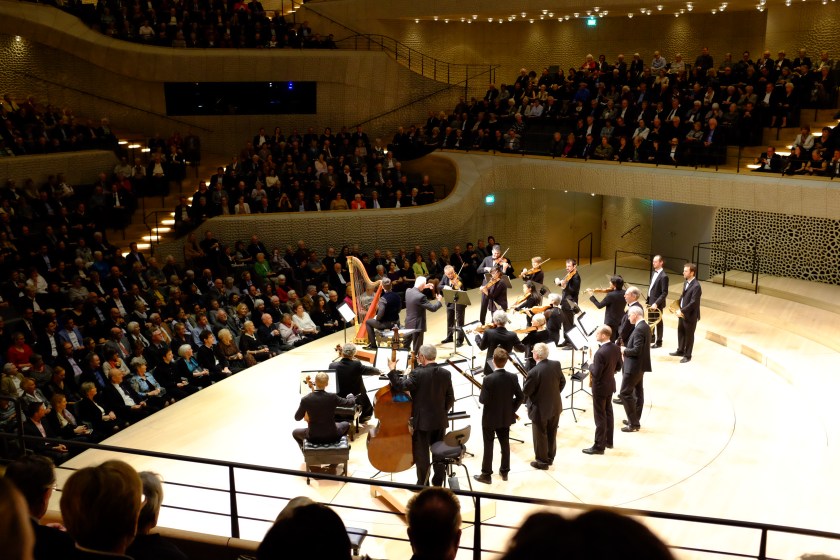
This time, last Sunday, was my first time in the actual large hall. I had heard wonders about the supposedly fabulous acoustics and had seen pictures from the inside. But actually being in there is just amazing.

I’ve previously been to other beautiful concert halls, like the Berlin Philharmonie that inspired this new layout of the audience sitting all around the orchestra, the KKL in Lucerne, or the Disney Concert hall in LA, but this beats them all.

Elbphilharmonie interior Grosser Saal (c) 2017 Musicophile
Inside the Elbphilharmonie: Grosser Saal

The only issue I have withthis venue is that most walls  look like they’ve been covered in egg cartons. And actually, they kind of are, an acoustic measure to optimize the sound experience.

William Christie – Les Arts Florissants – Xavier de Maistre 

I went to see a rather atypical ensemble for this hall: William Christie’s Baroque Ensemble Les Arts Florissants. This great period ensemble is well known for their baroque performances, I had seen them once before at the Barbican Hall (a much less beautiful venue) in London in a great performance of Purcell’s Didon and Aeneas.

Xavier de Maistre, William Christie, Les Arts Florissants Elbphilharmonie March 26, 2017 (c) Musicophile
Xavier de Maistre, William Christie, and Les Arts Florissants at Elbphilharmonie

Here they went into a repertoire a little bit later than their typical fare, as they were playing Harp concertos from the time of Marie-Antoinette, as in their recently released album.

So we got exposed to some lesser known composers such as Johann Baptist Krumpholz and Johann David Hermann (the literature for harp concertos isn’t very large).

The concert opened with a lively played Kleine Nachtmusik (Little Night Music), one of the most well known Mozart pieces. It is not my favorite and I had never heard it play live, but it was a refreshing opener.

Krumpholz concerto wasn’t really my cup of tea, so I spent the 2nd half of the part before the break admiring the beautiful venue.

After the break and a glass of Cremant de Loire, Christie started with Haydn.  And to answer my own question: no you don’t have to be Italian to conduct Haydn, being an American living in France will do just well. The performance of symphony no. 85, La Reine, was impressive, and made the small ensemble sound at times nearly like a full Beethoven orchestra.

And then things were wrapped up with de Maistre back on stage and Herman’s harp concerto, a much more convincing piece to my ears than Krumpholz.

All in all, a hugely enjoyable evening. If you’re lucky enough to get your hands on Elbphilharmonie tickets, go for it!

Shai Maestro Trio – Live At Moods – What A Night

Shai Maestro

I’ve been a fan of Shai Maestro since his very first solo album, see also this very early blog post of mine: This Avishai Cohen Alumni Will Go Places. I even put his debut album in My 25 Essential Jazz albums.

His most recent album I had more trouble with, most likely I just didn’t get it.

But when I saw he was playing again at Moods in Zurich (exactly 2 years after his first concert there, which I also saw), and I happened to be in town, I knew I had to see him.

And I’m extremely glad I did.

Shai Maestro Trio – Live At Moods Zürich – March 17, 2017


The concert was obviously mainly focused on his latest album, the Stone Skipper.

And as much as I didn’t get it when listening to the album, everything became extremely clear when listening to it live.

Shai Maestro during the concert mentioned that they don’t have a set playlist. They just have a common list of songs, but basically are guided by the mood of the evening.

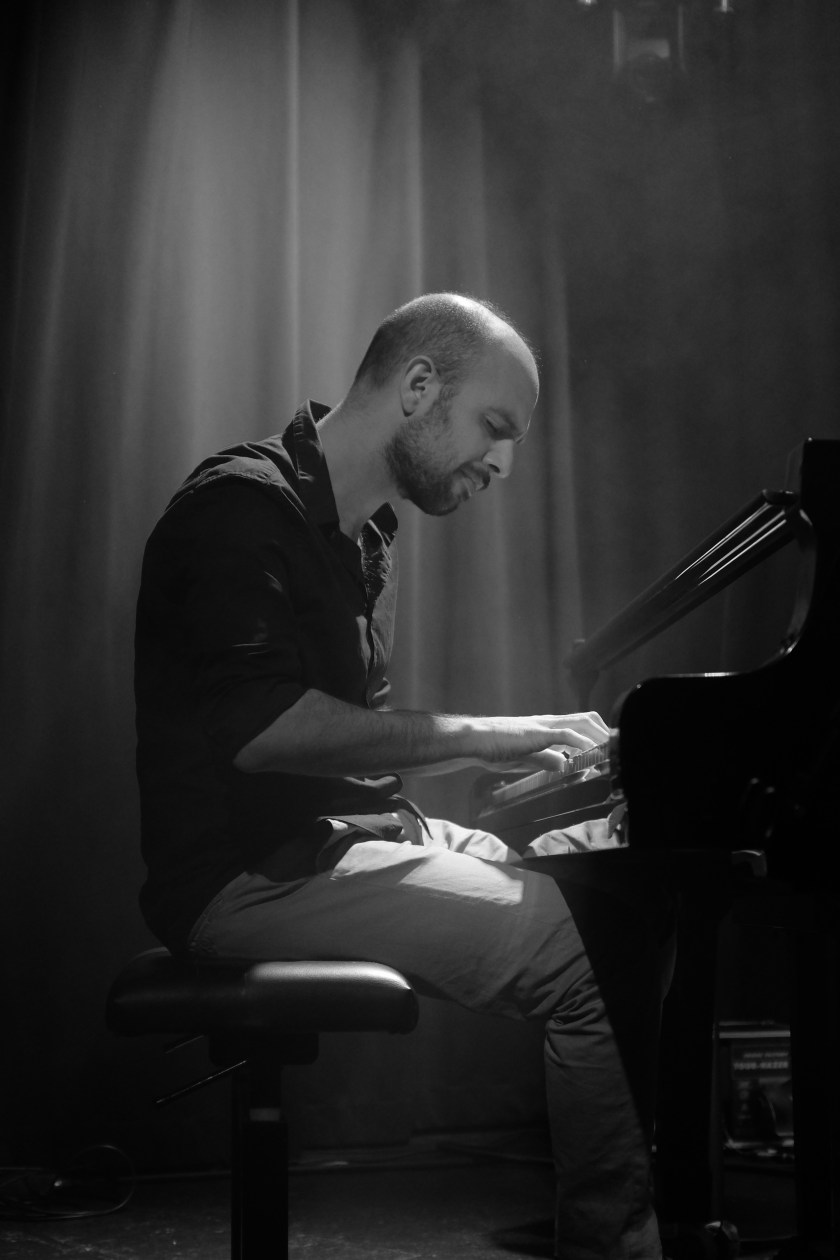
Shai Maestro on piano live at Moods March 17, 2017 (c) Musicophile
Shai Maestro

I guess the mood at Moods must have been good, because we got an amazing performance.

What sets this trio, that includes Jorge Roeder on bass, and Ziv Ravitz on drums, apart, is how much complexity they can blend into something that sounds so effortless.

Most jazz consists of simple 4/4 rythms. Not so here, the rythmic complexities that Ravitz pulls off and that his colleagues are following so easily, are so impressive, that when occasionally he switches to a regular 4/4 beat people start laughing because it sounds so simple in comparison.

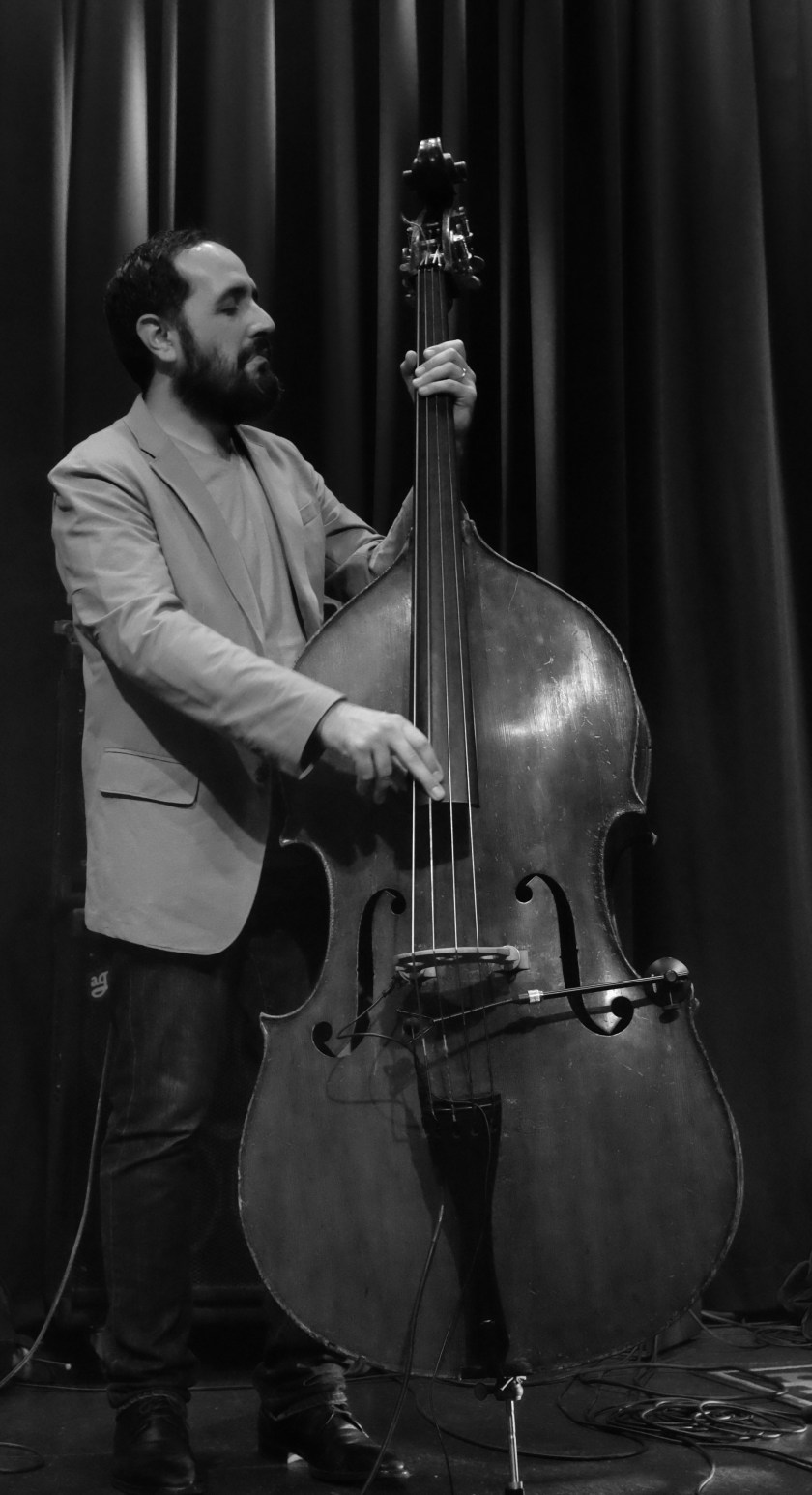
Jorge Roeger with Shai Maestro Live at Moods March 17 2017 (c) Musicophile
Jorge Roeder

Same goes fro the melodic complexities of Maestro. But unlike with some Jazz musicians, complexity is never a self-serving intellectual exercise, but always serves the mood of the piece, and is actually quite accessible even to non Jazz musicians.

Jorge Roeder, as a typical bass player, never puts himself at the forefront, but what an artist he is as well. The synergy between these three outstanding musicians it amazing.

Ziv Ravitz with Shai Maestro Live At Moods Mar 17 2017 (c) Musicophile
Ziv Ravitz


Maestro probably will never play standards (he jokingly said “I won’t play Autumn Leaves”), but this trio really creates their very own world, and a world you don’t want to leave again.

The audience agreed, and got the band to play 3 encores, and probably would have stayed for another 5 if possible.

So if you love Jazz, or even if you don’t, check out his website and his tour calendar, and do yourself a favor of experiencing this trio live.

I’ve been to many concerts in my life, this was one of the most memorable experiences I had.

Sorry for the many superlatives in this review, but I was simply blown away.

My rating: 5 stars

Rémi Geniet Plays Beethoven Sonatas – A Review

Beethoven’s piano sonatas

I haven’t written about Beethoven’s piano sonatas yet on this blog, except for mentioning Igor Levit’s beautiful rendition of the late piano sonatas here.

Why? No idea. It is such a massive body of work, 32 sonatas, no really weak stuff in there, the late sonatas being particularly challenging. How do you attack such a mountain, or more precisely mountain range?

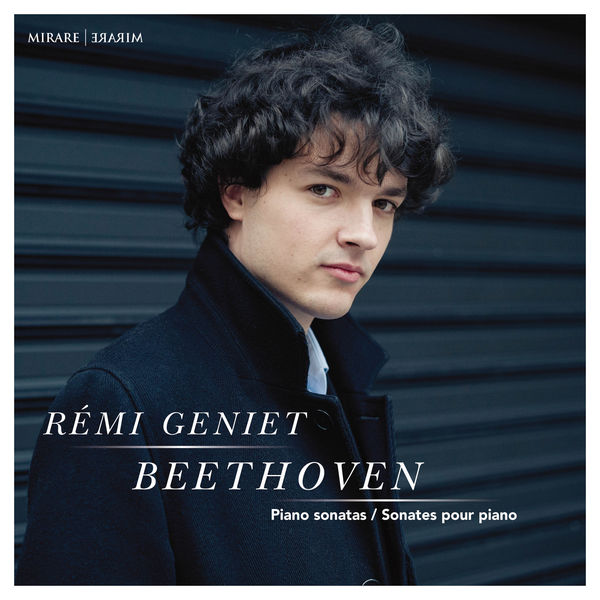
Rémi Geniet

Rémi Geniet, a young French pianist, must have asked himself the same question. His answer is an album that covers 4 sonatas from the very early op. 2 to the very late op. 110.

Who is Rémi Geniet? A young (born 1992) French pianist, who released a beautiful Bach album two years ago that was highly praised. He also won several competitions including the Horowitz International Competition in Kiew.

Geniet Plays Beethoven Sonatas

Rémi Geniet Beethoven Piano Sonatas Mirare 2017 24/96

From Bach to Beethoven. A small step? Well not really, actually anything but.  But Geniet manages this challenge beautifully.

You get a mix from Beerhovens sonata cycle, as mentioned above from the very early sonata no. 2 to the penultimate sonata no. 31.

The really famous sonata here is the “Moonshine“, no. 14, probably the piano piece that even non classical listeners will have heard at some point. Attacking such an earworm is obviously tricky, we all have some form of reference in our head. And what references, from Schnabel, to Arrau, to Brendel, or more recently Paul Lewis or Ronald Brautigam.

How does he compare against such great names of the piano? Well, actually, quite well.
Take the first movement. This, if done badly, can drown in kitsch. No kitsch here, you get  simplicty, very clean playing , no “fuzz”. But actually, this makes the entire experience nevertheless extremely intense.

He takes extremely technically challengingthird movement (Presto agitato) breathtakingly fast, but with extreme precision. Again, this is truly impressive.

All this really comes without neglecting musical substance. Take for example the sonata no. 31. Beethoven’s late sonatas, like his late string quartets, are works of extreme intellectual substance. You simply cannot gloss over them. Pianists typically only tackle them later in the career. But here, similar to Levit mentioned above, Geniet just goes for it, and very successfully.

Overall rating: 4 stars (at certain moments of playing I’d give a 5 star, but there is so much competition out there in the Beethoven space, that it is hard to consistently outperform all the piano legends).

You can find it here (Qobuz) and here (HDtracks)

Gene Harris Quartet: Listen Here – So Enjoyable

Does good music need to be intellectually stimulating?

Well, personally I’d say yes, this for me is one of the key differentiators of the music I really like and that I write about on my blog, from what regularly tops the charts these days.

I guess most people like their music a bit simpler (I know this sounds condescending, but isn’t really meant this way), but for me, a certain level of complexity usually is a must for me to truly enjoy music.

That said, every once in a while, it is hugely enjoyable to have an album that is just right, but doesn’t overdo it from a complexity point of view. You can do a Goldberg or Diabelli variations every day.

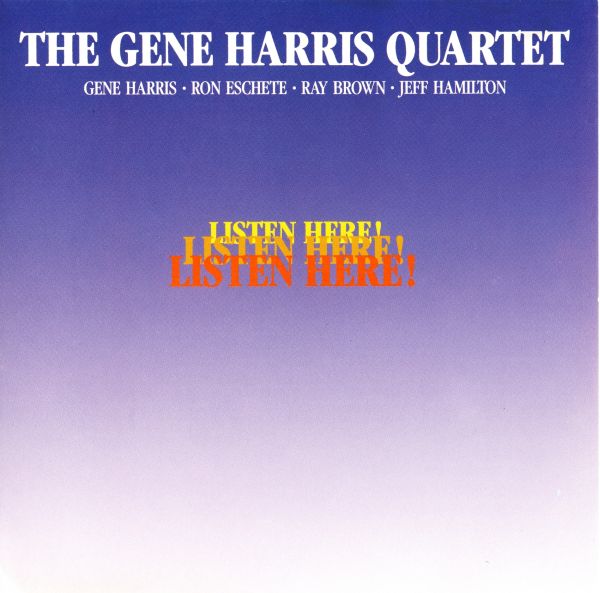
Gene Harris Quartet: Listen Here (Concord 1989)

The Gene Harris Quartet Listen Here Concord SACD Ron Eschete Ray Brown Jeff Hamilton

Listen here is such an album. Don’t get me wrong, this isn’t Jazz for simpletons, but it is straightforward mainstream Jazz.

But it does one thing right: it swings like crazy, and if you can listen to this without tapping your foot I’d be hugely surprised. Well, look at the cast: we’re actually talking about the Ray Brown trio of the 1990s here. Ray Brown, the bassist legend that grew up with the Oscar Peterson trio, at the time had surrounded himself with the brilliant pianist, Gene Harris, and the outstanding Jeff Hamilton (this guy can swing). I’ve already mentioned the Ray Brown Album Live At The Loa in my 25 Essential Jazz Albums, and have reviewed Jeff Hamilton’s excellent album Live here . So if you liked these two recommendations, this one is a no brainer.

We’re adding here the guitarist Ron Eschete, who switches between acoustic and electric guitars, and overall blends in so well, you could often think you’re listening to a piano trio album.

You get a nice mixture of standards and original compositions. And to add a cherry to the cake, Concord Jazz was known for their good sound quality of their recordings, so if you can find it, I suggest you get the 2003 SACD release of this album (its unfortunately out of stock, and not yet available as DSD download to my knowledge).

Talking about finding this album, I’m unclear about who owns Concord’s catalogue these days, but some of their albums are still quite hard to find even electronically.

I’ve added some links below, but for example, Qobuz, my personal favorite streaming provider (no affiliation) doesn’t even have the album. If you’re on Apple Music, you’re better off.

In any case, if you like swinging, melodic mainstream jazz that is just there to be enjoyed, it is worth going through the slight trouble of finding this little gem.

My rating: 4 stars  (I’m still a bit torn, this could even potentially be 5 stars, maybe I’ll change my mind eventually)

You can find it here (Amazon) and here (Apple Music)


Bologna 1666: Beautiful Baroque Music by Julia Schröder

Baroque Music

Let me start by saying, if you haven’t realized it yet from reading my blog, that I’m a huge fan of Baroque music. There is something about this era that fascinates me musically.

Obviously, there are the Big Names Bach, Händel, Scarlatti, Rameau, Vivaldi.

But beyond these big names there are many other composers that simply aren’t as much on our (or at least mine) radar screen yet.

The following album explores some of these names.

Bologna 1666 – Julia Schröder – Kammerorchester Basel (Deutsche Harmonia Mundi 2017)

0886445774955_600

So what exactly went on in 1666 in Bologna? Well, beyond the fact that the city was one of the cultural centers of Europe at the time, the Accademia Filarmonica was founded, one of the earliest musical schools in European history. Note that the Academy is still active to this day. The most famous pulis of this school were probably Corelli, and the legendary Farinelli.

What do we get on this album? There are several pieces by Giovanni Paolo Colonna, a name I must admit I hadn’t heard before, but this gentleman actually was one of the founders of the Academy. You get a bit of Torelli (not to be confused with Corelli obviously), and other “smaller” artists like Zavateri, Perti, or Laurenti that the world has forgotten about beyond some music scholars.

Is it worth checking out? Absolutely, yes! Quite often I’m pretty disappointed with music by e.g. lesser known composers (e.g. Ferdinand Ries), but here really there isn’t a disappointment. If at all, I actually prefer many of the pieces to let’s say the average Vivaldi violin concerto, and there is a lot to discover.

Julia Schröder

And how’s the playing? Well, it really is the highlight of the album. The Kammerorchester Basel is one of the best period chamber ensembles that we have in Europe right now (and let me count Switzerland as European for this purpose), their Beethoven cycle with Antonini was quite spectacular.

I had heard the name of Julia Schröder before, but this is the first time I actually heard one of her albums. She is a professor at Freiburg University (not very far down the Rhine from Basel), and her brilliant, nuanced, and tasteful playing of the lead violin is quite magical here.

Overall, this is not a must have album if you’re just starting out with your classical music collection (although I don’t think you’d be disappointed), but if you’re considering adding yet another Beethoven cycle or other classical warhorse to your existing classical music collection, I’d rather go for this new and exciting discovery.

My rating: 4 stars

You can find it here (Qobuz) and here (HDtracks)

Sarah McKenzie – Paris In The Rain – A Review (more or less)

I’ve previously praised the young Australian singer Sarah McKenzie for her last album on Impulse, We Could Be Lovers, have seen her perform live, and mentioned her in my Top 10 Jazz Covers of Pop songs. I was even able to exchange a couple of friendly words with her during the above mentioned concert.

So in a nutshell, I really like her. Hence, when I saw on Facebook that she is about to release a new album, I gotvery excited.

(Side note: following artists I like is one of the few useful purposes for me of Facebook. Why is it that in my generation the only people that regularly post updates are the ones you don’t care about? There seems to be some form of inverse correlation between posting activity and content value, with some rare exceptions)

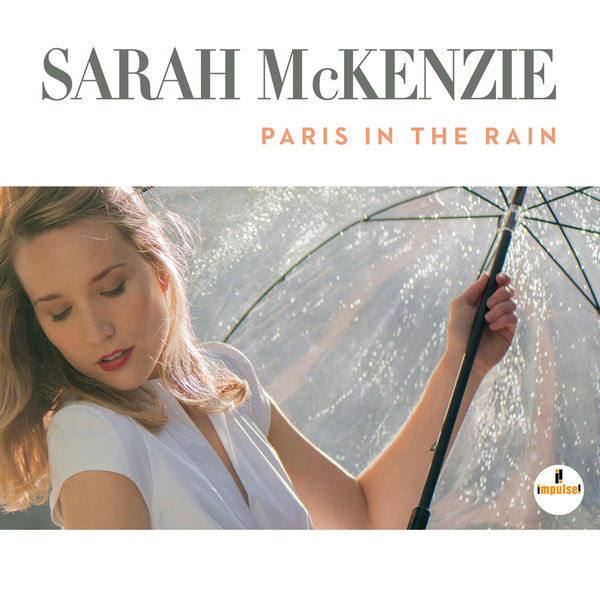
Paris In the Rain (Impulse 2017)

So, now the album has been out for weeks, and I’m only just about now writing about it.

Sarah McKenzie Paris In The Rain Impulse 2017 (24/96)

Why is that? Well, not because I didn’t listen to it enough. The thing is, I was really trying to like it, but in a way something was just a bit wrong. And I spent the last month trying to put my finger on it.

Is it the singing? Absolutely not, that’s beautiful as ever.

Is it the songs? No, we get standards, like Tea For Two, beautiful ballads, like Little Girl Blue, own compositions such as Paris in the Rain, see below (she also has 4 other own compositions on the album!).


Is it the musicians? Again, not really. Actually, they do play extremely well. Sarah and Impulse were able to assemble some great musicians here: Mark Whitfield und Romero Lubambo on guitar, Warren Wolf on the vibraphone, Reuben Rogers on bass, Gregory Hutchinson on drums.

The horns are excellent too, from Dominick Farinacci on the trumpet, Jamie Baum on the flute, to Scott Robinson and Ralph Moore on saxphone.

So what is it? It was only when I read that this album was produced again (like the previous one) by Brian Bacchus, when the penny dropped. It is just a bit too perfect! That may sound a bit silly, but the album could use a little bit of “dirtiness” to my ears.

Bacchus, while not a household name, has worked with some of the greatest names in Jazz (e.g. John Scofield). However, he also produced Norah Jones and Gregory Porter. Not that I’m comparing this album to Norah Jones, unlike her this is 100% Jazz, but you get the total perfection of a Norah Jones album. This really doesn’t fully replicate the full energy I felt when I saw her live. I’d really love it if her next album will be a live one!

So why I strongly encourage you to check out this album, I’d even more recommend you see her live. As mentioned, she’s on facebook, and here’s her website that has the tour dates.

My rating: 4 stars

You can find the album here (Qobuz) and here (Prostudiomasters).

Classical Life

A classical music blog by music critic Tim Mangan

This Week's Music

Making Classical Accessible

From my Macbook to the Net

Evaporation of my thoughts and observations

Elestra

Author: Artienne

My Life in Music

Playing, Singing and Listening

ArsX3

A brand new journal reviewing books, cinema, music

LawrenceEz's Blog

Creative and Performing Arts: Writing, Classical Music, Photography

Laetitia Strauch-Bonart

Contemporary Politics & Culture

sibling revelry

reveling in all things classical

It's A Raggy Waltz

I collect jazz on vinyl, I dig the Dave Brubeck Quartet, & I write about it

La Musica

By two cousins

thejazzbreakfast

Dishing it out from the heart of England

only jazz

random thoughts about music that matters to me

The Culture Project

Exploring the world of literature, wine, art, music and more.

René Spencer Saller

The music causes me to dream of fabulous empires, filled with fabulous sins.

Breaking Baroque

Blog of Tafelmusik Baroque Orchestra and Chamber Choir

Tasting Nirvana

Eating your Dosha

Shadow of Iris

Poetry, fiction, short stories, more ...

The Immortal Jukebox

A Blog about Music and Popular Culture

April Greene

Writer + Editor

a pianist's musings

A history of your favorite classical music.

Classical music for all

Boris Giltburg's blog

I HEAR VOICES

An orchestra seat in the web space